
So I was perusing through the STR* forums and found a thread titled Tapered Head Tubes – Debate.
[*STR = So Cal Trail Riders, my handle, dwsand3r]
I went ahead and threw my two cents in and decided to share my response here, but I added a sketch for extra dork points!
“Most of the force from your fork (a really long lever arm*) is dispersed into the lower headset cup. That is why the lower is 1.5”.
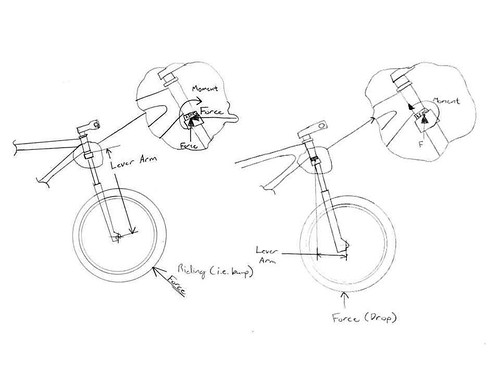
Note: for all the engineering types, I did not show all forces, nor did I balance these forces. This is not an accurate free body diagram, just a quick conceptual sketch.
Remember many years ago, just before the switch to the 1.125″ standard, how common it was for a frame and/or lower headset cups to fail. The remedy was to move onto thread-less oversize (1.125″) headsets & steerer tubes. This also was during the time frame when 100mm of fork travel was huge and a 2 foot drop was gnarly! Also the fork was a pretty weak, noodle like member.
Most bikes offering the 1.5″ or tapered head tubes are designed for 140mm+ travel forks (even longer lever arm, that is why you’ll void many warranties by running a fork longer than the manufacturer specifies*), the forks are incredibly stiff (35+mm stanchions), and a 6 foot drop won’t even get you a photo in your friend’s blog.
The 1.125″ standard is fine for XC and 90% of trail riders out there.
The 1.5″ and/or tapered is a great thing for the rest of us. That is why 1.5″ stems are only available in shorter lengths. It is assumed if you’re running 1.5″ you’re a free rider or D/H and you’re running a short stem.
*lever arm : imagine if you were to put a pipe in your bike’s head tube and then pulled on the pipe in an attempt to break the head tube off the frame. It be a lot easier to do with a longer pipe than a short one.
“Give me a lever long enough and a fulcrum on which to place it, and I shall move the world.” – Archimedes”
Comment with what you think, should the whole industry go to 1.5″? Should 1.5″ be abolished? Is taper the ultimate middle ground?

-
-
-
-
-
Show CommentsI and my friends rode some vicious trails with that old-timey 1″ headtube standard (late 80s) and a TON of BMX flatland, pools and halfpipes in the late 70s/early 80s, and I never saw any rash of frame/headset cup failures. Sure, the bearings needed replacing from time to time, just like they do now. And if a cup failed, it was often the top cup or just the crown race…and often easily repairable if your shop had the parts on hand.
The new “standards” are all marketing BS for the most part — companies have to create new stuff in order to sell products.
Still, your diagrams make sense…there is a lot of load down there, so the bigger bearing, the better.
I should add that IF there is a frame failure at the headtube/downtube junction, it’s not because the steerer or bearing is undersize…it’s purely a function of the “lever arm” of the fork. That’s why most frames have a gusset down there…not to mitigate damage from undersized cups and bearings but to resist the lever force of the fork.
Ghost Rider – Both very good points, I should have clarified that when the frame is damaged, it is due to the load, not the size of the steerer tube/headset.
I’ve seen frame damage in two ways, one in which the downtube has buckled, the other in which the head tube has been ripped off the front of the bike. In the latter case a 1.5″ head tube is useful in the extra weld area it allows (assuming a larger downtube, is used). Though a gusset also accomplishes the same effect.
This makes me wonder, what ever happened to the pierced tubes that were the rage in the early 90’s.
Your first comment makes me suspect that you ride a lot smoother/better than I do! Also it reminds me that I weighed a lot less in the 80s!
I’d like to think I was fairly smooth…but many of my friends were certainly not! And I should disclose that I’ve never weighed more than 139 lbs. in my entire life — so I’m potentially easier on equipment than heavier riders.
A lot of the tapered steerer marketing hype, at least in the roadbike world, focuses on increased front-end stiffness (for increased steering precision). THAT makes sense, I suppose…but then again I don’t think we were lacking in the stiffness department in the 1″/ 1.125″ days, either. But hey, new things often turn out to be a blessing once the market has developed.
I can see 1.5″ for FR and DH, tapered oh the other hand, I kind of look at it like 650B the un-necessary, niche un popular kids in high school saying “what about me??” from the back of the classroom.