Trek Demo: Trek Top Fuel 69er Ponderings & Musings

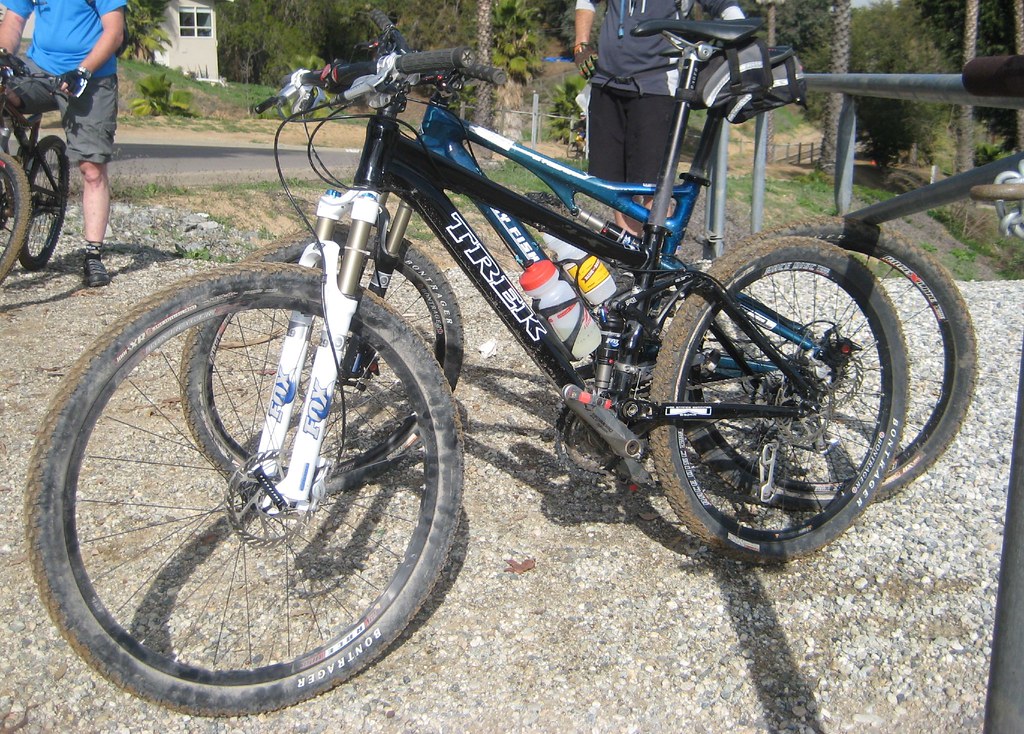
Trek Top Fuel 69er. 29 in front, 26 in back
At the Trek Demo this past weekend I got to get on the Trek Top Fuel 69er. It was a size Medium when I normally ride a Large. But that’s OK, because I wasn’t testing out the bike so much as I was testing the concept of running a 29-inch wheel up front and a 26-inch wheel in the rear. Regarding the concept, well, let’s just say that I’m not totally sold on it.
Trek has not fully jumped into the 29er world, at least not with both feet or in this case with both wheels. Trek over the past year has put out three bikes with a 29er front wheel and a 26� rear wheel, 69ers. The 69ers are a brown hardtail 69er single speed that is more expensive than the geared hardtail version of itself and a full suspension 69er, which I demo’d at the demo. The reason Trek decided to go in this direction rather than going full 29er is because they believe a 29er front wheel and a 26inch rear wheel is the best of both worlds.
Quick summary of benefits: In order to get the benefits of the 29er wheels, that being rollover ability, momentum, and larger contact patch, Trek decided to put the 29er on the front wheel. In order to negate the 29er’s disadvantages, that being slow acceleration and weight, Trek went with the 26 inch wheel out back. Sounds like a good idea but how would this work out in the real world?
In the real world, it works as described. The 29er front wheel still rolls over rocks, railroad ties, curbs and a lot of other stuff the trail threw at it while the rear wheel did make the bike accelerate faster. No surprises there. So if it works, then why am I not sold on this yet? One word: momentum. I rode the Trek 69er right after riding the Gary Fisher HiFi 29er. And within a mile of cruising along, I knew that I was losing momentum on the Trek faster than I did while riding the Gary Fisher. How did I know this? Because I had to pedal earlier to keep my speed up.

Check out the BAD form. Jumps are not my forte and I should have eaten it here.
Could it have been the tires? Nope. The GF was equipped with tires I’d consider gripper than the Trek (Jones ACX versus the Jones XR respectively) which meant the GF would probably create more friction and therefore slow down earlier than the Trek. Could it have been weight? Maybe, as the GF was equipped with slightly better parts but I would be willing to bet the reason I lost momentum sooner was because the 26� wheel out back required more pedaling to keep it going at speed.
To a lesser degree, I was not sold on the 26â€? wheels ability to roll over obstacles as well as the 29er up front. None of this is scientific, but I did find that my rear wheel almost didn’t clear a ledge I’ve cleared dozens of times with a 29er front/rear setup. I did clear this little obstacle, but I almost dabbed. eeks! The front tire, by the way, rolled over the little ledge fine.
To me, it boils down to this: the benefits of being able to keep momentum leads to less pedaling on my part which then leads to longer rides because I use less energy pedaling. I’m not a racer, so faster acceleration is not of utmost importance to me rather being able to ride for longer periods of time is important to me and thats why I’m sticking with my 29er. Although I’m not sold on the 69er concept I think the Trek Top Fuel 69er would work well for the racer who wants the best of both worlds.
Check out the Trek Top Fuel 69er here.


Far out description on your experience with a 69er. I have to ask, did it do well on singletrack? I have a 29er now and it doesn’t do singletrack’s slow switchback very well because it’s tall/tippy and have a toe overlap. I love the 29er’s ability to roll over everything with ease and I am wonder if a full suspension 69er would do well on slithering technical switchbacks you usually see on singletracks. I occasionally pedal at Tamarancho in Fairfax, CA and I use my Santa Cruz Heckler all the time there but there are times I want to bring my 29er and couldn’t be it’s just so damn tippy and hard to balance it. OO well. LMK, okay!
🙂
Pepe: What kind of 29er do you have? I’ve ridden a bunch of 29ers and have never had any problems with toe overlap (I have big feet too, size 13).
In terms of the 69er’s ability to clear switchbacks: I wouldn’t know for sure. The loop I rode the 69er on did not have switchbacks to clear. I would think the steering would resemble the 29er due to the front end geometry to handle the front wheel.
Best way would to figure out if the 69er would work for you would be hook up with Trek’s Demo Van to test one out. Say “hi” to Matt, the Trek demo guy. Matt is a cool, laid back guy who does his job very well. Click here for the info.
Then let me know how it went! Happy riding.